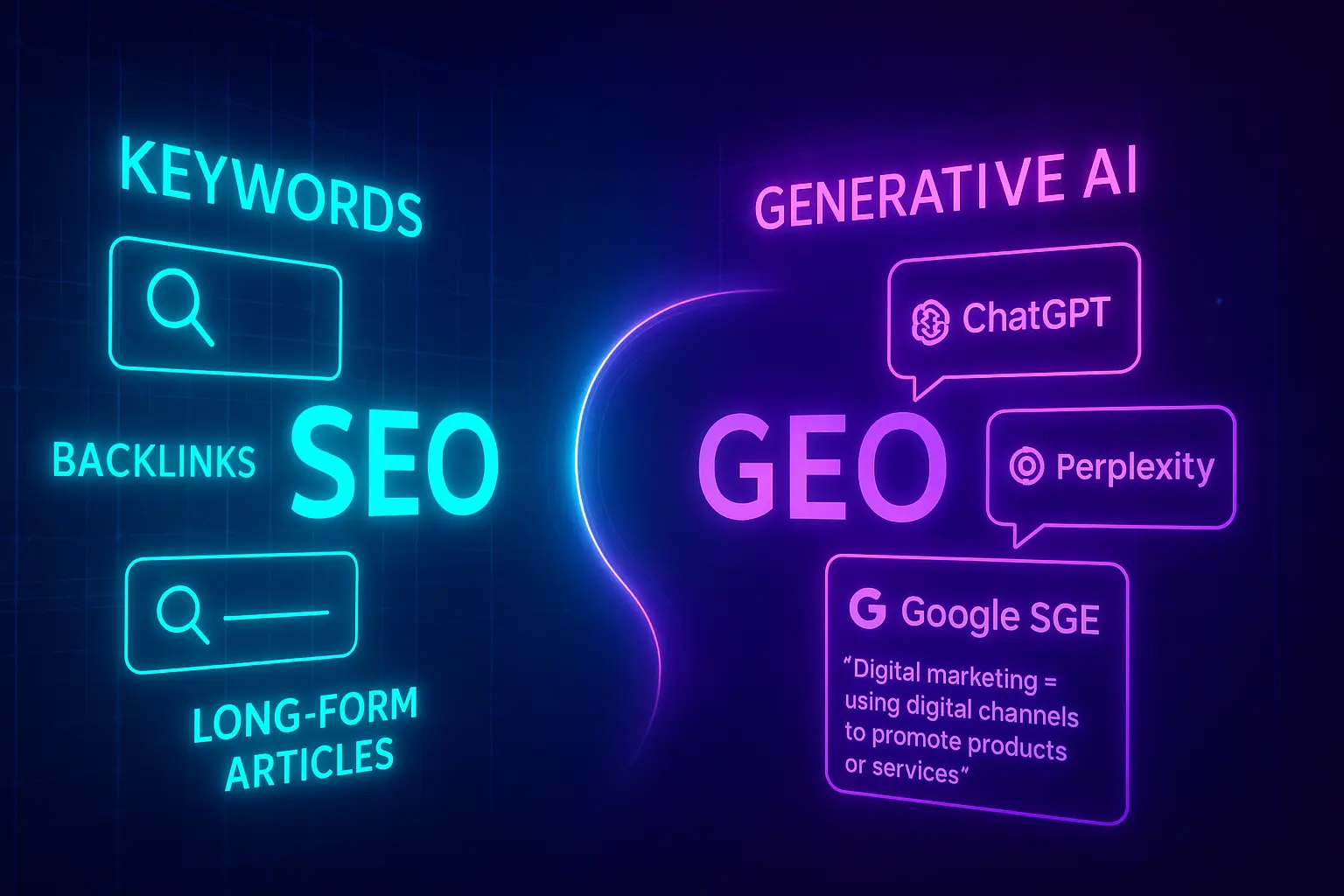
Generative Engine Optimization is the answer to changing search behavior and the rise of generative AI-powered engines. Marketers who combine the best of SEO with GEO tactics focusing on quality, structure, and expertise will lead in the future of visibility and digital marketing.
Key Points
- GEO (Generative Engine Optimization) is the practice of optimizing content for inclusion in answers from generative AI search tools like ChatGPT, Perplexity, and Google’s SGE.
- GEO focuses on context, factual accuracy, semantic relevance, and “AI-friendly” structuring rather than just keyword density and backlinking.
- Search behavior is shifting: users increasingly receive direct answers/overviews in AI interfaces instead of clicking through search result links.
- Marketers must adapt content creation, keyword strategy, and optimization practices to stay visible as SEO and GEO converge and diverge.
What Is GEO? Why Has It Emerged?
Generative Engine Optimization (GEO) is the process of making digital content easily discoverable, interpretable, and “answerable” by generative AI engines such as ChatGPT, Perplexity, and Google’s Search Generative Experience (SGE). GEO emerged because people now rely less on browsing blue links and more on instant, conversational answers delivered by advanced language models embedded in search engines.
- These engines don’t just match keywords they generate context-aware, concise responses from multiple sources.
- Visibility now depends on whether AI systems cite, summarize, or surface your content directly inside answers not simply where you rank in classic SERPs.
How Generative AI is Changing Search Habits
- Users ask natural, conversational questions, expecting instant summaries, recommendations, and even follow-ups from the search engine itself.
- Voice search, visual search, and mixed media results are increasingly common.
- Brands with strong topical authority, clear structure, and expert-backed facts are now favored by AI engines, reshaping the foundation of digital marketing strategy.
GEO vs. Traditional SEO: Core Differences
Content Strategy
1. Approach
- SEO: Keyword-centric, narrative rich.
- GEO: Focus on Generative AI results.
2. Content Length
- SEO: In-depth articles, long-form guides.
- GEO: Optimized for concise AI-friendly answers.
3. Purpose
- SEO: Drive clicks, page visits.
- GEO: Provide instant, referenced answers.
4. Optimization
- SEO: Meta tags, backlinks, user experience.
- GEO: Structured for AI search visibility.
Keyword Optimization
- SEO uses short-tail and broad keywords for ranking.
- GEO leverages semantic keywords, natural language queries, long-tail and question based phrases that match spoken and conversational search.
User Intent
- SEO focuses on search intent by funneling users to websites for answers or purchases.
- GEO aims to fulfill informational needs instantly often without users leaving the search engine interface.
Ranking Factors
1. Backlinks
- SEO: Essential for authority.
- GEO: Contextual citations for E-E-A-T.
2. Technical SEO
- SEO: Crawlability, speed, UX.
- GEO: Structured data, schema, clarity.
3. Content Structure
- SEO: Engaging, flowing.
- GEO: Direct, segmented, AI-readable.
4. Domain Authority
- SEO: More important to SEO.
- GEO: Relevant but less dominant for GEO.
Practical Examples: Adapting for GEO
- Write content with clear sections, headers, summaries, and direct answers to frequently asked questions.
- Use structured data (schema markup) to clarify what your page is about for AI engines.
- Prioritize accuracy, originality, and first-hand expertise think case studies, reviews, interviews, and trustworthy sources.
- Research and implement natural, conversational keywords: for example, “How to start a digital business in India” and “Best social commerce practices for 2025.”
- Create content clusters and topic hubs to build topical authority—not just a single optimized page.
Challenges and Future Outlook
- Challenge: GEO requires fundamental rethinking of content from framing expertise to structuring information for AI parsing.
- Challenge: Measuring success is trickier; clicks and traffic can decline even as citations in AI-generated answers rise.
- Future Outlook: As generative AI engines blend with traditional search, marketers must optimize for both link-based and direct-answer visibility. The best strategies will blend content marketing, technical SEO, and generative engine structuring.
FAQ
Q: Does GEO mean traditional SEO is obsolete?
A: No. Traditional SEO still drives organic traffic and site rankings; GEO is a parallel discipline focused on AI-driven search, and the two increasingly complement each other.
Q: How do I know if my content is GEO-friendly?
A: Content should be factually accurate, clearly structured, answer-focused, and backed by citations and expertise—making it easy for AI engines to reference and surface in their output.
Q: What if my traffic drops should I blame GEO?
A: Traffic patterns are changing; being cited and referenced by AI engines is a new metric for success. Optimize for both click-through and inclusion in generative answers.
Q: Are backlinks still important in GEO?
A: Contextual citations matter more than sheer backlink quantity; links should be relevant, reputable, and reinforce your expertise.
Also Read : The Hidden Power of Video Transcripts and Captions in SEO.
How Voice Search is Changing SEO Strategies.
The Real Problems Holding Brands Back on Social Media in 2025.